
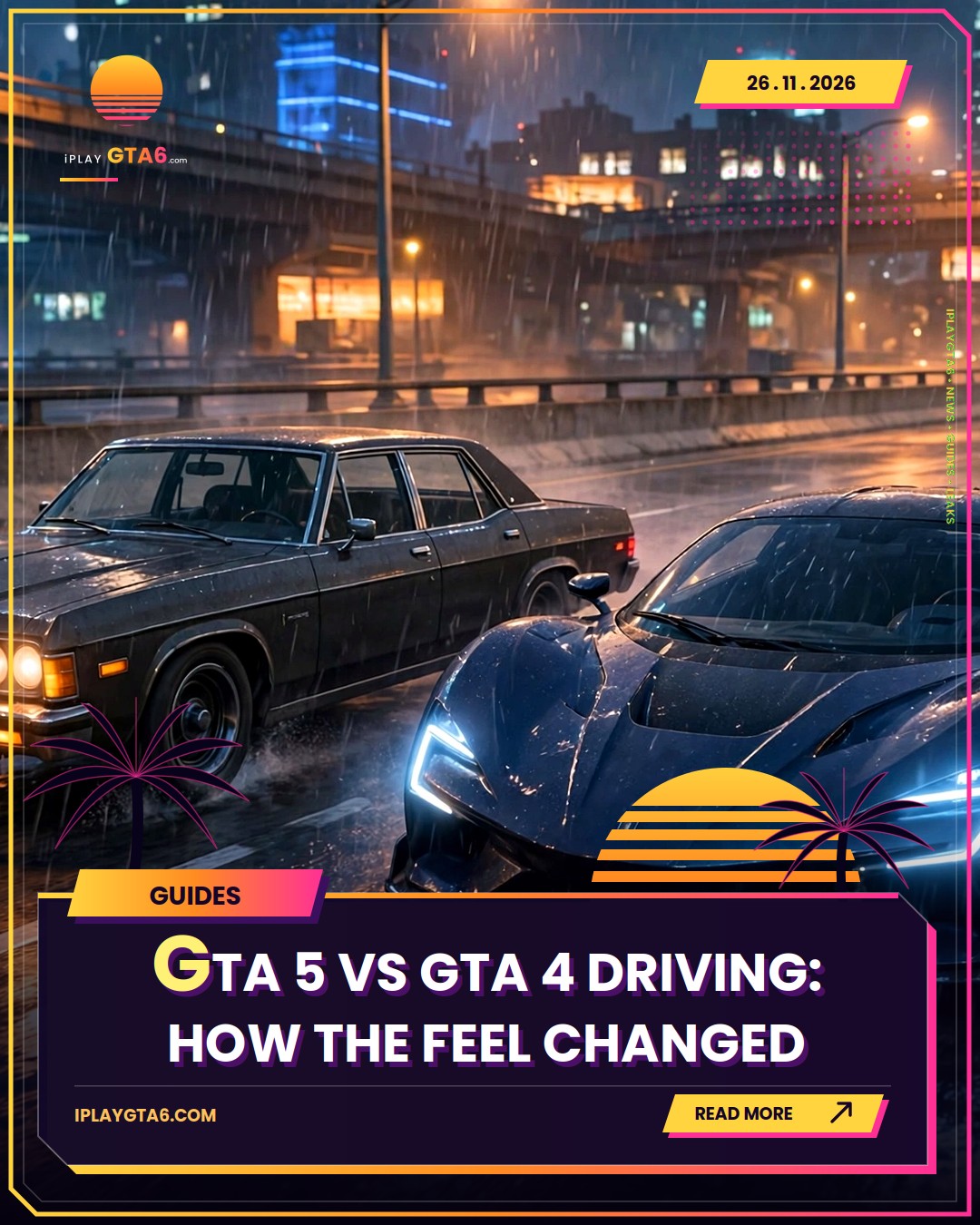
Ask any GTA player which game drives better and you will start an argument. GTA 4's cars feel heavy, slow to settle and punishing when you get a corner wrong. GTA 5's cars feel light, grippy and forgiving, built for high-speed chases and stunts. Neither is an accident. Rockstar rebuilt the driving model between the two games, and the change tells you everything about what each game was trying to be.
This is a straight comparison of how driving feels in GTA 4 and GTA 5: the weight, the handling, the crashes, the bikes and boats, and why Rockstar made the change. If you want to see where the series went next, our GTA 5 vs GTA 6 driving comparison picks up the story with the newest game.

GTA 4: Heavy, Demanding and Physical
GTA 4's driving is built around weight transfer. Cars lean into corners, react to abrupt steering and take time to settle after braking. Large sedans show what one handling analysis called boat-like levels of body roll, and understeer is a real problem: enter a corner too fast and the front tyres push wide, and holding more steering does not save you. Weight shifts forward under braking and rearward under acceleration, so throttle and brake timing decide your line through a turn.
The result is slower and less forgiving than GTA 5, but every car has a recognisable character. The game shipped with just under 120 cars and motorcycles, and drivetrain differences matter rather than every vehicle feeling like a cosmetic shell. A heavy sedan, a taxi and a sports car do not just look different: they stop, turn and slide differently, and you feel it in the controller.
The Physics Behind the Weight
GTA 4 pairs Rockstar's RAGE engine with NaturalMotion's Euphoria system, which creates reactive character and vehicle behaviour. Impacts deform cars more dramatically, occupants react to collisions, and a bad landing or a side swipe can leave you recovering instead of carrying on at full speed. The deformation is exaggerated compared with a real crash, but it serves the game's design: Liberty City is a grimy, grounded place, and the driving makes it feel that way.
The same physics show up on foot. Niko Bellic reacts to impacts with real weight and momentum, and a high-speed crash can throw him through the windshield. Collisions feel consequential in a way no later GTA game has matched, and that consequence is exactly why some players still call GTA 4 the most immersive game in the series.
GTA 5: Tight, Forgiving and Built for Fun
GTA 5 deliberately moved the other way. Cars feel lighter, more responsive and more planted, with handling tuned for accessibility rather than simulation. The cars stick to the road better, spinouts and rollovers are rarer, and high-speed driving is far more manageable. Chases, jumps and stunts that would end in a ditch in GTA 4 become routine in GTA 5, and that is the point: the game wants you doing them.
The change was not a technical step backwards. GTA 5 still runs on RAGE, but the handling values were retuned for a different kind of game: a brighter, broader Los Santos sandbox with three protagonists, and above all GTA Online. The realistic physics of GTA 4 would have made Online's fast-paced, chaotic multiplayer practically unplayable, so Rockstar tuned the handling toward arcade fun that works when dozens of players are crashing into each other.

At a Glance
| GTA 4 | GTA 5 | |
|---|---|---|
| Driving feel | Heavy, demanding, pronounced weight transfer and understeer | Tight, forgiving, predictable, faster to master |
| Body roll | Strong, especially in large sedans | Minimal, cars stay flat |
| Crashes and damage | Exaggerated deformation, occupants thrown around | More simplified, cars survive more |
| Spinouts and rollovers | Common if you push too hard | Rare, grip saves you |
| First-person driving | No first-person driving view | Full first-person mode on foot and in vehicles |
| Best for | Slow, careful, immersive city driving | Chases, stunts and multiplayer chaos |
Crashes, Damage and Consequences
The difference is clearest in a crash. In GTA 4, a hard impact crumples the car, throws the driver and costs you real time as you recover. In GTA 5, the same impact is a bump: the car keeps going, the damage is cosmetic for longer, and you are back at full speed in seconds. GTA 4 treats a crash as an event. GTA 5 treats it as a minor interruption, because in GTA 5 you are expected to crash constantly.
That trade-off splits players cleanly. Drivers who value realism and immersion pick GTA 4 every time: the weight, the consequences and the way Liberty City's bleak atmosphere reinforces the driving. Players who value fun and accessibility pick GTA 5: the handling is easier to learn, the skill ceiling for stunts is higher, and the game never punishes you for driving fast. Damage modelling kept evolving after both games, too: our vehicle damage guide explains whether mods and body kits make cars tougher in GTA 6.
What Changed, and What Did Not
What changed between the games is the priority, not the engine. GTA 4 prioritised believable physics and AI even at the cost of approachability, while GTA 5 prioritised a cinematic, satirical sandbox where driving is a way to get to the fun, not the fun itself. The handling, the ragdoll physics and even the pedestrian reactions all moved in the same direction: less simulation, more spectacle.
What did not change is that both games are still recognisably GTA behind the wheel. The radio, the traffic, the wanted system and the joy of threading a car through city traffic at speed are there in both. And the debate never really ended: every new GTA game since has been judged against both poles, GTA 4's weight and GTA 5's fun. GTA 6, with its Leonida map dwarfing Los Santos, has to satisfy both camps at once, which is why its driving model borrows from each.

Quick Questions
Why does GTA 4 driving feel heavier than GTA 5?
GTA 4 was tuned for weight transfer, body roll and understeer, with RAGE and Euphoria physics making cars feel heavy. GTA 5 retuned the same engine toward lighter, grippier, arcade handling.
Is GTA 4 driving more realistic than GTA 5?
Yes, in feel. GTA 4's cars lean, slide and deform more like real weight, while GTA 5's handling is deliberately forgiving and arcade-like.
Why did Rockstar change the driving in GTA 5?
GTA 5 prioritised accessible fun and GTA Online multiplayer, where GTA 4's realistic physics would have made fast-paced chaotic play frustrating.
Which GTA has the best driving?
It depends on what you value. GTA 4 wins on realism and immersion; GTA 5 wins on accessibility, stunts and multiplayer.
Does GTA 5 have first-person driving?
Yes. GTA 5 added a full first-person mode on foot and in vehicles. GTA 4 has no first-person driving view.
How many vehicles are in GTA 4?
Just under 120 cars and motorcycles, with drivetrain differences that genuinely change how each one handles.